

Zinn vs. Pedego vs. Segway: Which ...
A step-through e-bike can make getting on and off the bike easier, but that doesn’t mean every step-through model will ...
A step-through e-bike can make getting on and off the bike easier, but that doesn’t mean every step-through model will feel right once you’re riding. Frame proportions, motor response, riding position, suspension, battery capacity, and adjustability can all change the experience.
That matters even more when comparing Zinn, Pedego, and Segway. These brands take noticeably different approaches. Pedego focuses on accessible, comfort-oriented production e-bikes; Segway emphasizes technology and performance, while Zinn builds custom e-bikes around the individual rider.
This comparison looks beyond headline specifications. Instead of simply asking which bike has the most power or longest claimed range, we’ll look at fit, frame design, motor systems, comfort, customization, technology, and overall value. Those factors can matter much more once you’ve owned and ridden an e-bike for months or years.
Zinn Cycles approaches the step-through category from a custom-bike perspective. The company has built personalized e-bikes in several configurations, including upright hybrids and step-through bikes, rather than limiting riders to one fixed frame design.
The eZinn Step-Through Hybrid Deore takes a custom-bike approach to the step-through e-bike category. Rather than asking riders to choose from a fixed set of production frame sizes, the bike is built around the rider's measurements, proportions, and riding needs.
That approach is particularly relevant for riders who don’t fit neatly into standard production sizing. Zinn’s custom e-bike specifications can accommodate rider heights from approximately 4’7” to 7’6” on several models, with custom crank lengths from 140mm to 210mm and stem lengths based on body geometry.
Pedego takes a production-bike approach, but accessibility and ease of use are central to its step-through models. The Boomerang, for example, uses a low step-through frame to make mounting and dismounting easier, along with a low center of gravity intended to make the bike easy to maneuver.
Pedego offers different wheel and frame configurations, with its current Boomerang models covering riders from roughly 4’10" to 6’3", depending on the version.
Pedego also builds its ownership proposition around local support. The company advertises a nationwide dealer network, local service and support, and a five-year warranty on its current Boomerang lineup.
Segway takes a more technology-focused approach to the step-through category. Its Xafari combines a step-through frame with a suspension-oriented design and connected technology. Segway’s documentation identifies the Xafari as a step-through e-bike, while the company’s product materials emphasize suspension, battery capacity, motor performance, and smart connectivity.
The Xafari targets riders who want more than basic electric assistance. Its design combines an upright riding position with adjustable rider-contact points and a technology package intended to add convenience and connectivity to everyday riding.
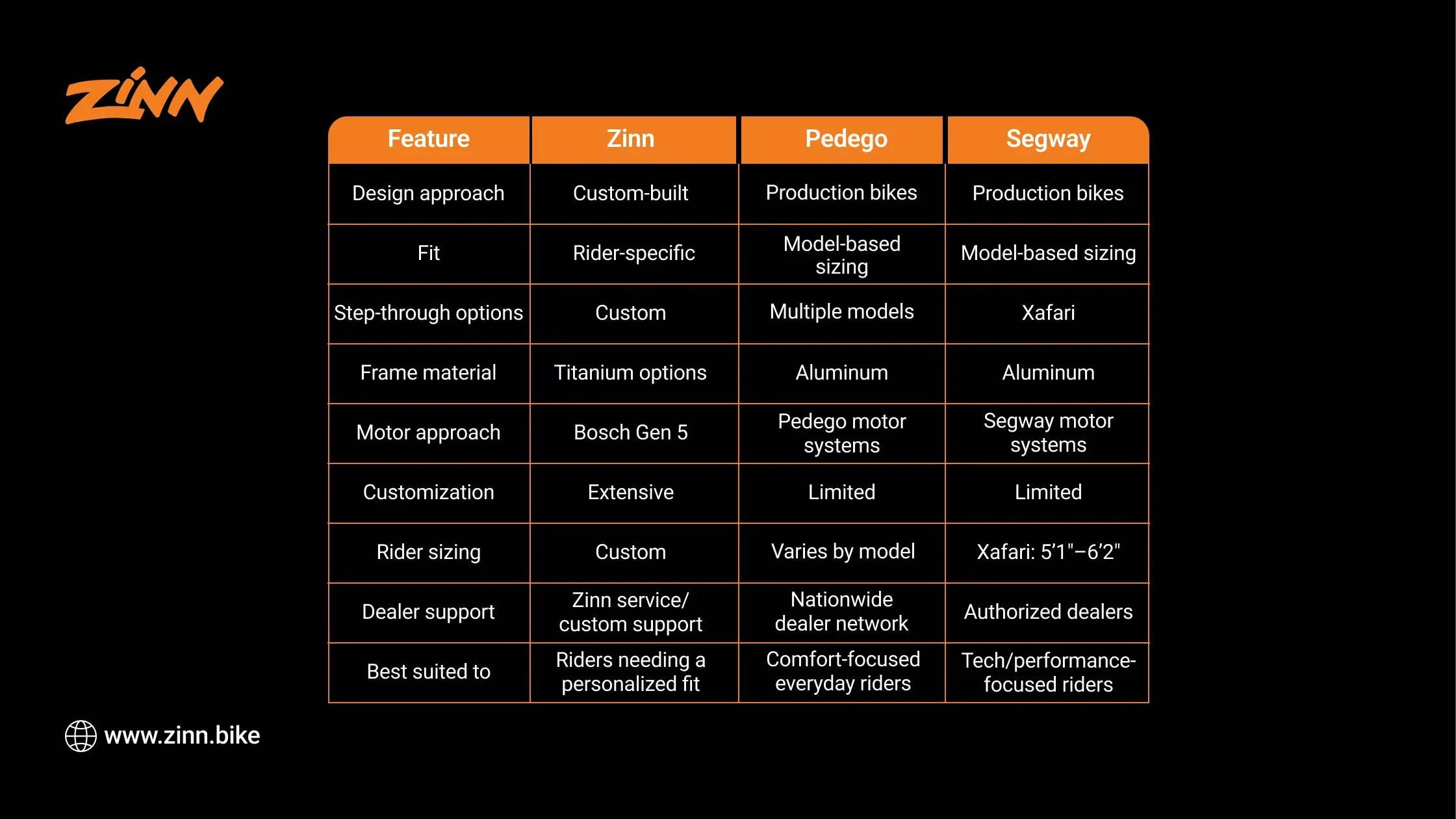
The differences become clearer when you look beyond the fact that all three offer step-through designs.
Zinn focuses on personalized fit and lightweight custom construction, Pedego emphasizes accessible comfort and practical everyday features, while Segway combines step-through accessibility with suspension and connected technology.
The right choice depends on which of those priorities matters most to you.
Zinn Cycles takes the most personalized approach to fit. Its custom e-bikes are built around the rider’s measurements and can be configured with different frame geometries, crank lengths, stem lengths, and riding positions.
The bike supports custom crank lengths from 140mm to 210mm, which gives riders with unusually short or long legs more flexibility than a standard production crankset. This makes the eZinn particularly relevant to riders who fall outside conventional sizing ranges or have struggled to find a comfortable position on production e-bikes.
The Boomerang uses two step-through configurations, with 24-inch and 26-inch options. Pedego lists an overall rider-height range of approximately 4’10” to 6’3”+, depending on the configuration. It also offers an adjustable handlebar stem, letting riders fine-tune the cockpit after choosing a frame. Pedego notes that its height recommendations are general guidelines because individual proportions and preferences can vary.
The Xafari uses adjustable components to accommodate a defined range of riders. Segway specifies an adjustable saddle, stem, handlebar, and display, with a recommended rider-height range of 5’1” to 6’2”. Its geometry includes a 413.6 mm reach, 631.7 mm stack, and 1,200.9 mm wheelbase.
Pedego and Segway give riders several adjustment points within a production frame. Zinn goes further by changing the bike’s underlying geometry to suit the individual rider.
The eZinn Step-Through Hybrid Deore uses a custom frame geometry rather than a fixed production design. Frame dimensions can be developed around the rider's measurements, preferred riding position, and step through requirements, with options for custom stem length, crank length, wheel size, and other components.
That gives the eZinn more room to accommodate unusual body proportions than a production step-through bike where the underlying frame geometry is fixed.
The Boomerang is built around accessibility and relaxed cruising. Its ultra-low step-through frame makes mounting and dismounting easier, while the adjustable stem allows the rider to change handlebar height and position. The bike also uses a suspension seatpost and an extra-wide cruiser-style saddle, reinforcing its comfort-focused design.
The Xafari combines a step-through frame with full suspension. It has 80 mm of front suspension and 70 mm of rear suspension, along with 26 x 3.0-inch all-terrain tires. Its upright geometry is intended to create a comfortable riding position while the suspension helps smooth rougher surfaces.
Pedego is oriented toward relaxed, accessible cruising, Segway adds suspension and all-terrain capability, and Zinn gives the rider considerably more control over the underlying geometry and riding position.
Does the weight of an e-bike matter? It does. A lighter e-bike tends to ride more like a traditional bike, with handling that feels quicker and more responsive. That lower weight can also make a noticeable difference when accelerating, braking, and moving the bike through corners. And off the bike, the benefit is just as practical: if you need to lift it onto a rack or load it into a car, a lightweight e-bike is simply easier to manage.
Zinn takes a lightweight custom-bike approach, with e-bike weights varying by frame size, materials, motor system, and components selected. The company’s eZinn Step-Through Hybrid Deore can start at around 36 lb with the Bosch 400wh battery and lightweight wheels and tires, while the Tui Step-Thru is listed at approximately 38 lb. This gives Zinn a significant weight advantage for riders who want a full-power e-bike that's easier to handle, transport, and maneuver. The battery is also easily removable on the Zinn bikes, which drop 6-10 lbs of weight, making loading into a vehicle much easier.
The Boomerang from Pedego is considerably heavier than Zinn’s lightweight builds. Pedego lists the 24-inch Boomerang at approximately 54–56 lb without the battery, depending on the model, and the 26-inch versions at approximately 56–58 lb without the battery. The battery adds additional weight, bringing the ready-to-ride bike closer to the mid-to-high 60-pound range. The extra weight reflects its comfort-oriented production design and equipment.
The Xafari from Segway is the heaviest of the three, with Segway listing a net weight of approximately 92.5 lb (42 kg). Its substantial weight comes alongside a 936Wh battery, full suspension, wide 26 x 3.0-inch tires, and other equipment designed for comfort and capability across varied terrain.
Zinn offers the clearest weight advantage, particularly for riders who value a lightweight e-bike. Pedego sits in the middle, while Segway's Xafari prioritizes battery capacity, suspension, and features over low weight.
The eZinn Step-Through Hybrid Deore uses a Bosch Gen 5 Active Line or Performance Line Speed mid-drive system, with up to 750W of maximum power and 85Nm of torque. Because the motor drives through the bicycle's drivetrain, assistance works with the rider's pedaling rather than powering the rear wheel independently.
The 2025 Boomerang uses a 52V brushless geared rear-hub motor rated at 749W nominal power and 60 Nm of torque. It offers five levels of cadence-based pedal assistance and a twist-and-go throttle, letting riders choose assistance through pedaling or throttle input.
The Xafari uses a motor with 80 Nm of maximum torque and 750W of maximum power. Segway pairs it with adaptive power assistance designed to respond to riding conditions, including when you need extra help.
All three provide substantial electric assistance, but their systems differ. Zinn uses Bosch’s mid-drive platform, Pedego uses a rear hub motor with throttle functionality, and Segway combines its motor with an adaptive assistance system and connected electronics.
Battery capacity and range depend on the custom build and selected Bosch system configuration. The eZinn Step-Through Hybrid Deore can be configured with a 400 Wh, 545 Wh, or 800 Wh Bosch battery, depending on the build and intended use. The different capacities give riders flexibility to prioritize a lighter setup or carry more energy for longer rides and higher-assistance use.
The Boomerang is available with 52V 10.5Ah or 17.5Ah batteries, and Pedego lists a maximum claimed range of up to 75 miles. Actual range will depend on factors such as assist level, terrain, rider weight, and conditions.
The Xafari has a removable 936Wh battery and a claimed maximum range of up to 88 miles. Segway also uses a smart battery management system and lets you charge the battery separately from the bike.
Segway publishes the largest headline range of these three specific models, while Pedego offers two battery capacities. Zinn’s range depends more on the individual custom configuration, so evaluate it based on the specific build rather than a single brand-wide number.
Comfort starts with fit. Because the frame can be designed around the rider’s proportions and preferred riding position, Zinn can address comfort through geometry rather than relying solely on suspension components. This can be especially valuable for riders who need a specific reach, crank length, or upright position.
The Boomerang takes a straightforward comfort approach with a suspension seatpost, wide cruiser saddle, ergonomic city handlebar, wide tires, integrated lights, and an adjustable stem. Heavy-duty spoke or mag-wheel options are also available for riders who want additional wheel support.
The Xafari emphasizes suspension and technology. Its 80 mm front and 70 mm rear suspension, hydraulic disc brakes, 3-inch tires, and upright geometry are designed for comfortable riding beyond smooth pavement.
Zinn’s technology focus is centered on the Bosch e-bike system rather than turning the bike into a connected gadget. The Bosch Gen 5 platform provides the motor and control system, while the rest of the bike can be configured around the rider’s priorities.
Pedego focuses on practical riding features, including its PedalSense system, five assist levels, twist-and-go throttle, integrated front and rear lights, and LCD controls. Its approach is straightforward and focused on ease of use.
Segway has the strongest technology focus of the three. The Xafari includes a multifunction display with navigation and ride data, smartphone connectivity, GPS-related functionality, integrated lighting, and a 20W USB charging port.
If connected features and built-in technology are high on your list, Segway has the most extensive package. Pedego keeps the controls practical and familiar, while Zinn concentrates its value on the underlying bike, fit, and Bosch-powered riding experience.
Price comparisons need to account for what each brand is actually selling. A production e-bike and a custom-built titanium e-bike aren’t directly comparable simply because both have electric motors and step-through access.
Zinn sits at the premium end because the purchase includes a personalized bike design rather than a fixed production frame. You’re paying for a lightweight bike with custom geometry, rider-specific component selection, premium materials such as titanium, and Bosch-powered performance. That makes the value proposition strongest for riders who prioritize fit and long-term ownership.
Pedego occupies a more accessible premium position. Its value comes from comfort-oriented production bikes, practical features, dealer support, and warranty coverage. It’s a compelling option for buyers who want a ready-to-ride step-through e-bike without going through a custom design process.
Segway puts more of its value into technology, battery capacity, suspension, and performance features. The Xafari’s large battery, suspension system, connected technology, and high-power motor appeal to buyers who want a feature-rich e-bike without moving into a custom-bike price category.
The right question isn’t simply “Which one costs less?” It’s “Which features and capabilities will I actually use?” A rider who needs a custom fit may get greater value from Zinn’s personalized approach, while someone who wants suspension and smart technology may prefer Segway. A buyer who values local dealer support and a comfortable production bike may find Pedego the better match.
Zinn, Pedego, and Segway aren’t designed around exactly the same type of rider.
|
Rider Type / Priority |
eZinn Step-Through Hybrid Deore |
Pedego Boomerang |
Segway Xafari |
|---|---|---|---|
|
Fit |
Custom rider-specific geometry |
Standard production sizing |
Standard production sizing |
|
Rider height |
Custom fit for a broad range |
Approx. 4'10"–6'3"+, model dependent |
5'1"–6'2" |
|
Crank length |
Custom 140–210mm |
Standard/model-specific |
Standard/model-specific |
|
Frame |
Custom titanium |
Production frame |
Production frame |
|
Motor |
Bosch Gen 5 mid-drive |
Rear hub motor |
Rear hub motor |
|
Weight |
Starts at 36 lb w/battery |
Approx. 54–58 lb before battery, model dependent |
Approx. 92.5 lb |
|
Suspension |
Fit-focused design. Suspension fork, seatpost, and stem optional upgrades. |
Suspension seatpost |
80mm front + 70mm rear |
|
Battery |
Bosch options based on build |
52V options |
936Wh |
|
Wheel/tire setup |
Custom wheel options |
24" or 26", model dependent |
26 × 3.0" |
Your best choice depends on what you value most, whether that’s personalized fit, easy everyday riding, smart technology, or a combination of those features.
No single winner emerges when comparing Zinn, Pedego, and Segway. Each brand takes a different approach to step-through e-bikes, and the right choice ultimately depends on how well the bike fits your body, riding style, and long-term needs.
Zinn Cycles takes a fundamentally different approach from mass-produced e-bike brands. Rather than asking riders to adapt to a fixed frame size and geometry, Zinn builds custom e-bikes around the individual rider. Measurements, proportions, preferred riding position, crank length, cockpit dimensions, and intended use can all influence the final build.
That personalized approach can be especially valuable for riders who are shorter or taller than average, have unusual body proportions, or have struggled to find a production e-bike that feels comfortable and natural. Zinn also offers premium frame materials such as titanium and Bosch-powered e-bike systems, letting riders combine a highly personalized fit with high-end components.
If fit and long-term riding comfort are your top priorities, Zinn Cycles offers something a standard production e-bike cannot: a bike built around you rather than a bike you have to fit yourself to.
If you’re ready to find a step-through e-bike built around your fit and riding goals, connect with Zinn Cycles to discuss your options.
That depends on what you value. Pedego focuses on accessible production e-bikes and dealer support, while Segway emphasizes technology, suspension, and battery capacity. Zinn stands apart with lightweight, superior ride quality, custom geometry and rider-specific fit, making it especially suited to cyclists who don’t fit standard production-bike proportions.
Zinn is the strongest option when standard sizing doesn’t fit. Its custom e-bikes can be designed around individual measurements, while Pedego and Segway rely primarily on fixed production-frame designs with adjustable components.
Yes. Pedego’s Boomerang lineup focuses on low-step accessibility, comfort, and everyday usability. Features such as an adjustable stem, suspension seatpost, wide saddle, and integrated lights make it well-suited to casual riding and commuting.
Yes. The Xafari uses a step-through frame and adds front and rear suspension, wide tires, hydraulic disc brakes, and a large battery. Segway lists the recommended rider height at 5’1” to 6’2”.
It can be, especially if you’ve struggled with standard bike sizing or experience discomfort on production bikes. Custom geometry lets you select the frame and components around your body proportions and riding position, instead of forcing you to adapt to a fixed frame. It also means a much lighter bike that rides more like a regular bike and is easier to transport.
Range depends on the specific model and riding conditions. The Segway Xafari has a claimed range of up to 88 miles, while the Pedego Boomerang Pro claims up to 75 miles. Zinn’s range varies by custom build and Bosch battery configuration and can range up to 100 miles, so evaluate it based on the specific bike being built.

A step-through e-bike can make getting on and off the bike easier, but that doesn’t mean every step-through model will ...

If you’re a tall rider, you’ve probably sized up everything on your bike except one part: the cranks. You went with a ...

Finding the right bike size isn’t as simple as matching your height to an XS, L, or XL. Height is a useful starting ...