---
title: Best Bikes & E-Bikes for Short Riders (Under 5’4”)
description: "Find the best bikes for short riders under 5'4\". Learn what affects bike fit and explore custom options from Zinn Cycles for greater comfort and control."
image: https://blog.zinn.bike/hubfs/best-bikes-e-bikes-for-short-riders.jpg
---
- [clydesdale bicycles](https://www.zinn.bike/bikes/clydesdale-bicycles/)
- [ZINN Custom Bikes](https://www.zinn.bike/)
- [Tui Bikes](https://www.zinn.bike/bikes/tui-bikes/)
- [303-499-4349](tel:303-499-4349)
- [Login or Create account](https://www.bigandtallbike.com/myaccount.asp?__hstc=248507544.90448e05af5b6838a0b3ffd1e40c765f.1752502478952.1753346888326.1753362879282.6&__hssc=248507544.2.1753362879282&__hsfp=945770823)
- [View Cart](https://www.bigandtallbike.com/message.asp?msg=49&__hstc=248507544.90448e05af5b6838a0b3ffd1e40c765f.1752502478952.1753346888326.1753362879282.6&__hssc=248507544.2.1753362879282&__hsfp=945770823)
[](https://www.zinn.bike/)
[](https://blog.zinn.bike/)
- [Home](https://www.zinn.bike/)
- [Contact Us](https://zinncycles.com/contact/)
Open main navigation
Close main navigation
- [Home](https://www.zinn.bike/)
- [Contact Us](https://zinncycles.com/contact/)
# Best Bikes & E-Bikes for Short Riders (Under 5’4”)
TECHNICAL GUIDE
# Best Bikes & E-Bikes for Short Riders (Under 5’4”)
13 min read
Jul 28, 2026
Team Zinn Cycles
Jul 28, 2026, 6:30:00 AM
[Team Zinn Cycles](https://blog.zinn.bike/author/team-zinn-cycles)
Share: [facebook-f icon](http://www.facebook.com/share.php?u=https://blog.zinn.bike/best-bikes-and-e-bikes-for-short-rider) [linkedin-in icon](http://www.linkedin.com/shareArticle?mini=true&url=https://blog.zinn.bike/best-bikes-and-e-bikes-for-short-rider) [Twitter icon](https://twitter.com/intent/tweet?url=https://blog.zinn.bike/best-bikes-and-e-bikes-for-short-rider) [pinterest-p icon](http://pinterest.com/pin/create/link/?url=https://blog.zinn.bike/best-bikes-and-e-bikes-for-short-rider) [envelope icon](mailto:?body=https://blog.zinn.bike/best-bikes-and-e-bikes-for-short-rider)
Most bikes on the market are built for riders between 5’7” and 6’2’’. If you're under 5’4”, that leaves you outside the range almost every mainstream frame was manufactured for, whatever your gender.
You stand over the frame, and there isn’t enough clearance.. You feel lower back and neck pain on longer rides. The bike feels like a boat and lacks responsiveness.
*Sound familiar?*
So you assume the problem is you, or that you just need to “get used to it.” You don't. The problem may be the bike.
Manufacturers build around the most common rider segment, then shrink the same frame and call it an XS. But a scaled-down bike isn't the same as a bike built for your proportions. Shorter reach, lower standover, proper wheel size, and the right crank length. These aren't small details. They're the difference between a bike that you don’t feel like riding and one that you can’t get enough of.
This blog breaks down why fit is so hard to find under 5’4’’, what to look for instead of just a size label, and how to finally choose a bike that feels like it was made for you, because it can be.
## **What Are Common Problems Short Riders Face**
When a bike is too large, or its geometry doesn’t suit a smaller rider, several issues can appear. Some of the most common problems include:
- Difficulty touching the ground comfortably when stopping.
- Feeling stretched out when reaching for the handlebars.
- Neck, shoulder, or wrist discomfort on longer rides.
- Poor control at slower speeds.
- Toe overlap during tight, low-speed turns.
- Feeling unstable.
These problems don’t necessarily mean you need a different style of bike. Often, they simply indicate that the bike wasn’t designed around the proportions of short riders. Choosing a bike built specifically for smaller cyclists can improve comfort, control, and confidence from the very first ride.
## **Why Bike Geometry Is More Important Than Frame Size**
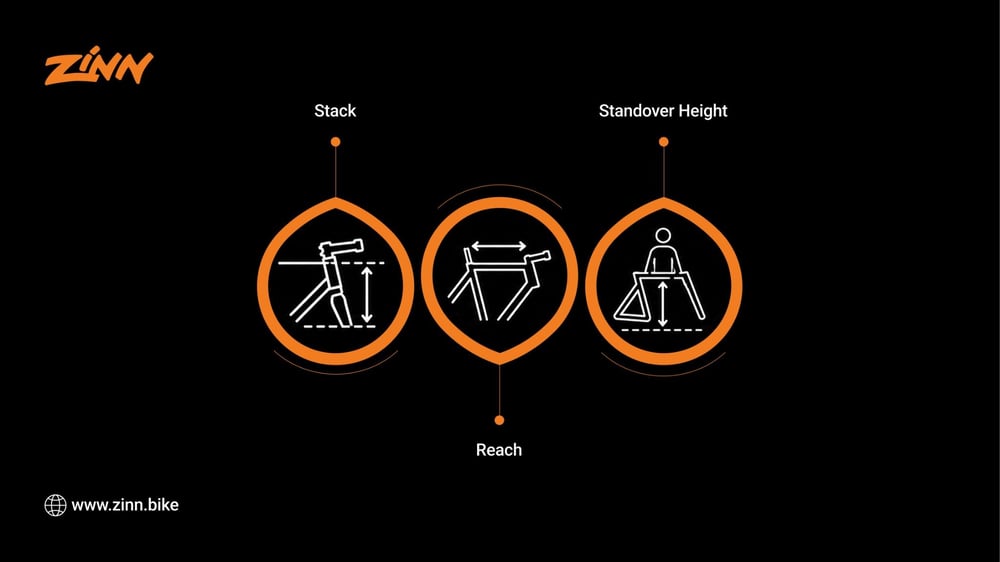
Many riders focus on finding the correct frame size, but that’s only part of the equation. Two bikes labeled as an XS or Small can feel completely different because of their geometry.
For short riders, three measurements have the biggest impact on comfort and control: stack, reach, and standover height. Understanding these numbers can help you choose bikes for short women that truly fit, rather than relying solely on a sizing chart.
### **Stack**
Stack measures the vertical distance from the bottom bracket to the top of the head tube. Simply put, it determines how high the front of the bike sits.
For many short riders, a slightly taller stack creates a more comfortable riding position by reducing the drop from the saddle to the handlebars. This can help relieve pressure on the neck, shoulders, and lower back, especially during longer rides.
### **Reach**
Reach is the horizontal distance from the bottom bracket to the top of the head tube. It determines how far you have to stretch to reach the handlebars.
A shorter reach generally works better for riders with shorter torsos because it allows for a natural bend in the elbows and a more relaxed upper-body position. If the reach is too long, even changing the stem may not fully solve the problem, and the bike can begin to feel awkward to handle.
### **Standover Height**
Standover height refers to the height of the top tube when you're standing over the bike.
Adequate clearance makes it easier to get on and off the bike and helps you stop confidently at traffic lights or on uneven ground. If there's little or no clearance, the bike may simply be too large, regardless of what the size chart says.
## **Signs Your Bike Is Too Big**
A bike that's too large can affect your confidence and overall riding experience. While small adjustments can improve the fit, they can't completely compensate for a frame that's the wrong size.
Here are some common signs that your bike may be too big:
- You can’t comfortably stand over the frame.
- You have to stretch to reach the handlebars.
- Your elbows are almost straight while riding.
- You regularly experience neck, shoulder, wrist, or lower back pain.
- You’ve installed a very short stem just to make the bike comfortable.
- The bike feels difficult to control, especially at slower speeds.
- You avoid stopping on uneven ground because the bike feels too tall.
If several of these signs sound familiar, it may be time to look beyond frame size and consider bikes for short women, with smaller proportions in mind. A bike with the right geometry can provide a more balanced riding position, better handling, and greater confidence every time you ride.
## **What Makes a Great Bike for Short Riders?**
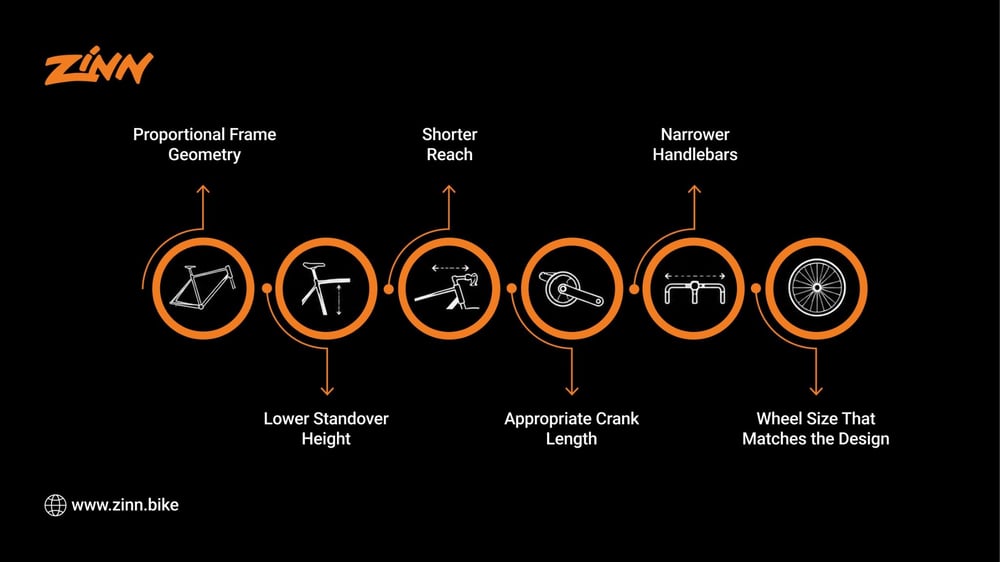
The best bikes for short women are designed around the rider’s proportions, not simply offered in a smaller frame size. A bike that fits properly feels easier to control, more comfortable on longer rides, and more confidence-inspiring every time you get on the saddle.
Here are the features that matter most.
### **Proportional Frame Geometry**
Frame geometry has a greater impact on fit than the size label alone. A bike with shorter reach, appropriate stack, and a lower standover height is more likely to fit a petite rider than a standard frame that's simply been scaled down.
When the geometry matches your body proportions, you'll experience:
- A more natural riding position
- Better weight distribution
- Improved handling and stability
- Less strain on your upper body
### **Lower Standover Height**
A lower standover height makes mounting, dismounting, and stopping much easier. It also gives short riders more confidence when riding in traffic, stopping at intersections, or navigating uneven ground.
Instead of feeling like you're balancing on a bike that's too tall, you'll feel more secure every time you come to a stop.
### **Shorter Reach**
Reach is one of the biggest fit challenges for petite cyclists. If the handlebars are too far away, you'll naturally stretch your arms and shoulders forward, which can lead to discomfort and reduced control.
A shorter reach helps:
- Keep a comfortable bend in your elbows
- Reduce pressure on your neck and shoulders
- Improve steering confidence
- Create a more relaxed riding position
### **Appropriate Crank Length**
Crank length should match your leg length, not simply come standard with the bike. Cranks that are too long can make pedaling feel awkward and increase strain on your knees and hips.
Shorter crank arms can provide:
- A smoother pedal stroke
- Better pedaling efficiency
- Improved comfort on longer rides
- Reduced joint stress
### **Narrower Handlebars**
Many stock bikes come with handlebars that are too wide for petite riders. Since handlebar width should roughly match shoulder width, narrower handlebars often provide a more natural riding position.
The right handlebar width can improve:
- Steering control
- Comfort
- Confidence when cornering
- Upper-body posture
### **Wheel Size That Matches the Design**
The wheel size should also be proportional to the bike design and the rider. Just because most bikes have a certain wheel size, does not mean that a small bike should be force-designed around a specific wheel size just because it is popular.
For example:
- **650b and 27.5-inch wheels** are commonly used to create well-proportioned bikes for smaller riders.
- **700c (28-inch) wheels** can also work well when paired with the right frame geometry and adequate standover clearance.
Rather than focusing on wheel size alone, look for a bike where the frame, geometry, and components work together to create a balanced fit.
## **Which Bike Is The Best for Short Riders?**
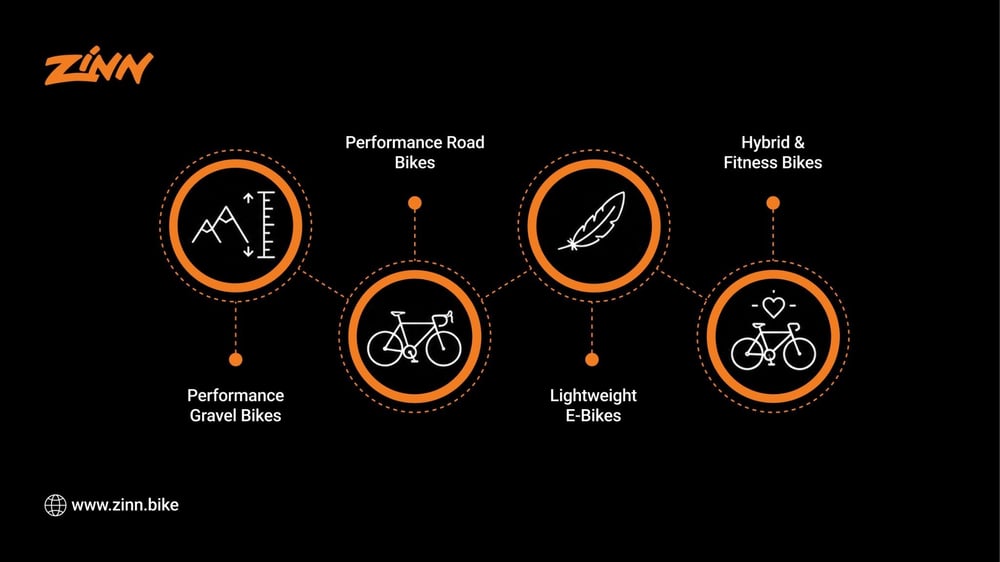
The best bike depends on where and how you ride. Fortunately, there are several options designed to meet the needs of short riders, whether you're commuting, training, or exploring new routes.
### **Performance Gravel Bikes**
[Performance gravel bikes](https://www.zinn.bike/bikes/tui-bikes/gravel-bikes/) combine the efficiency of a road bike with the comfort and versatility needed for mixed terrain. Their stable handling and ability to accommodate wider tires make them an excellent choice for riders who enjoy exploring beyond paved roads.
They’re ideal if you:
- Ride on pavement and gravel
- Enjoy longer adventures
- Want one bike for a variety of terrain
### **Performance Road Bikes**
[Performance road bikes](https://www.zinn.bike/bikes/tui-bikes/road-bikes/) are built for speed and efficiency on paved roads. For bikes for short women, proper geometry is especially important to create a comfortable riding position without excessive reach or an overly aggressive posture.
They’re best suited for:
- Fitness rides
- Endurance cycling
- Fast group rides
- Long-distance road cycling
### **Lightweight E-Bikes**
[Lightweight e-bikes](https://www.zinn.bike/bikes/tui-bikes/e-bikes/) provide pedal assistance while remaining easier to maneuver than heavier electric bikes. Their lower weight makes them easier to control, park, and transport, which can be especially beneficial for petite riders.
They’re a great option if you:
- Want help climbing hills
- Ride longer distances
- Commute regularly
- Are getting back into cycling
### **Hybrid & Fitness Bikes**
[Hybrid and fitness bikes](https://www.zinn.bike/bikes/tui-bikes/hybrid-fitness-bikes/) are designed with comfort and versatility in mind. Their more upright riding position makes them a popular choice for recreational riders and anyone looking for a comfortable everyday bike.
They’re well-suited for:
- Casual rides
- Bike paths and greenways
- Fitness and exercise
- Everyday commuting
No matter which style you choose, the most important factor is finding a bike that fits your proportions. When bikes for short women are designed around the needs of petite riders rather than simply offering a smaller frame, every ride becomes more comfortable, more efficient, and more enjoyable.
## **How to Choose the Right Bike When You’re Under 5’4’’**
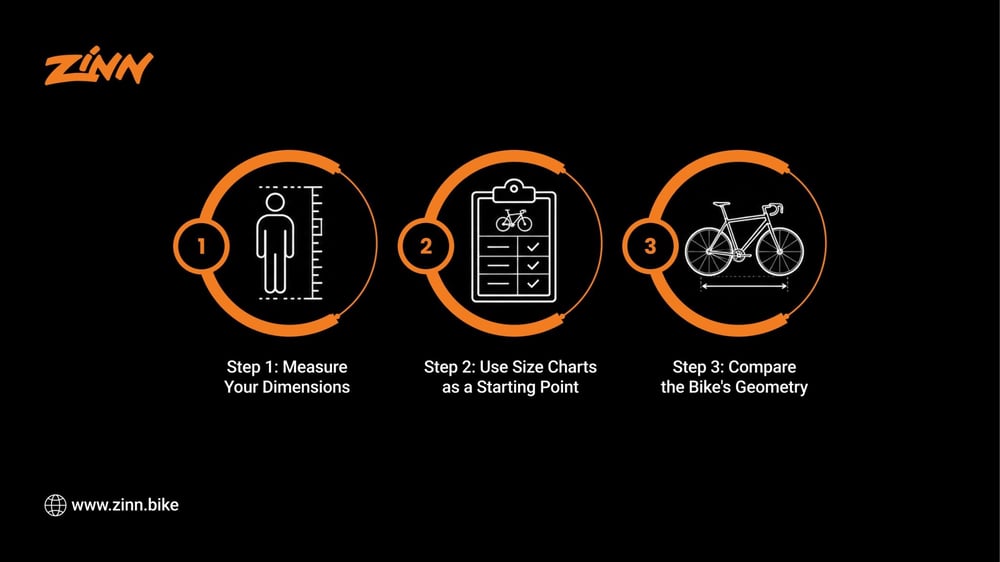
Finding the right bikes for short women starts with understanding your body measurements, not just your height. A bike that fits well will feel comfortable, stable, and easy to control, while the wrong fit can make every ride more challenging.
### **Step 1: Measure Your Dimensions**
Height is a useful starting point, but it doesn't tell the whole story. Before comparing bikes, take a few basic measurements, including:
- Height
- Inseam
- Torso length
- Arm length
These measurements help determine how a bike should fit your body. For example, two riders who are both 5’2’’ may need completely different bikes if one has longer legs and the other has a longer torso.
### **Step 2: Use Size Charts as a Starting Point**
Bike size charts are helpful for narrowing down your options, but they shouldn’t be the final deciding factor.
Many short riders fall between two frame sizes, such as XS and Small. Instead of automatically choosing a single size, use the chart to identify a suitable size range and then compare each bike's geometry.
Remember that one brand’s XS frame may fit very differently from another’s.
### **Step 3: Compare the Bike’s Geometry**
Once you’ve narrowed your choices, look beyond the size label and compare the geometry.
Pay particular attention to:
- **Stack**, which affects handlebar height.
- **Reach**, which determines how far you'll stretch to the handlebars.
- **Standover height**, which influences how comfortably you can stand over the bike.
These measurements provide a much better indication of how a bike will fit than the frame size alone.
## **When Does a Bike Manufactured Specifically for Short Riders Make Sense?**
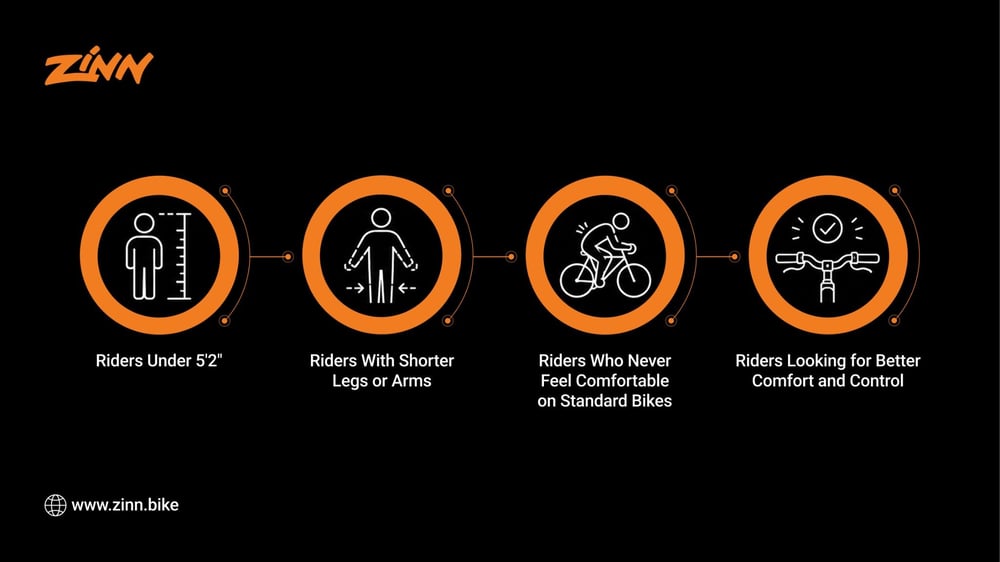
Many riders can find a comfortable fit on a stock bike. However, if you’ve struggled to find a bike that truly fits, one designed specifically for petite cyclists may be a better option.
### **Riders Under 5’2’’**
As rider height decreases, finding a well-fitting stock bike becomes more difficult. Bikes designed around smaller proportions can provide better reach, lower standover height, and more balanced handling.
### **Riders With Shorter Legs or Arms**
Height isn’t the only factor that affects fit. If you have shorter legs, a shorter torso, or shorter arms than average, you may need a bike designed around those proportions rather than simply a smaller frame.
### **Riders Who Never Feel Comfortable on Standard Bikes**
If you’ve tried multiple bikes and still can't get comfortable, the issue may be the bike's geometry rather than its size.
You may benefit from a purpose-built bike if you:
- Always feel stretched out.
- Struggle to reach the handlebars comfortably.
- Feel unstable when stopping.
- Continue making fit adjustments without solving the problem.
- Experience recurring neck, shoulder, or wrist discomfort.
### **Riders Looking for Better Comfort and Control**
A bike specifically for short riders can improve much more than comfort. It can provide better handling, increased confidence, and a riding position that feels natural from the very first ride.
Instead of adapting your body to the bike, the bike is designed around your body.
## **Find Your Perfect Custom Bike with Zinn Cycles**
[](https://www.zinn.bike/service/contact-us/?__hsfp=ce6831f2859e9c94e15e2d3573ede66a&__hssc=253282838.1.1784706660854&__hstc=253282838.1c66d9b5d794858181bba8d43e7483a3.1775572454471.1784138117962.1784706660854.18)
Finding the right bikes for short women shouldn't mean settling for the smallest frame available. The best bike is one that's designed around your height, proportions, and riding style.
That’s exactly why [Tui Titanium Bikes](https://www.zinn.bike/bikes/tui-bikes/) was created. Backed by more than 40 years of experience at [Zinn Cycles](https://www.zinn.bike/), Tui offers titanium bikes specifically designed for riders 4’8’’ to 5’6’’ tall. Rather than adapting standard frames, these bikes are engineered to provide the proper geometry, fit, and handling that many petite riders struggle to find elsewhere.
Whether you’re looking for Performance Gravel Bikes, Road Bikes, Lightweight E-Bikes, or Hybrid & Fitness Bikes, Tui offers options to help short riders enjoy greater comfort, confidence, and performance on every ride.
[Contact us now](https://www.zinn.bike/service/contact-us/).
## **Frequently Asked Questions**
### **What is the best bike for a woman under 5’4’’?**
The best bikes for short women are those designed with proportional geometry, appropriate reach, and a comfortable standover height. The ideal bike also depends on where and how you ride, whether that's on roads, gravel, bike paths, or for commuting.
### **What size bike should a 5-foot woman ride?**
Many 5-foot riders start with an XS frame, but sizing varies by manufacturer. It’s best to use size charts as a starting point and compare stack, reach, and standover height before making a decision.
### **Are e-bikes a good option for short riders?**
Yes. Lightweight e-bikes can be an excellent choice for short riders, especially when they’re engineered around smaller body proportions. They make climbing hills, longer rides, and daily commuting more enjoyable while remaining easy to handle.
### **Can short riders use bikes with 700c wheels?**
Yes. Many bikes for short women successfully use 700c wheels. What's most important is that the bike’s geometry is designed to accommodate the wheel size while maintaining proper fit and handling.
### **Why do many bikes feel too big for petite riders?**
Many bike manufacturers design their bikes around average-sized riders. Even the smallest frame may still have a reach, standover height, or overall geometry that's too large for petite cyclists, making the bike feel uncomfortable despite being labeled as the correct size.
TE
##### Written by Team Zinn Cycles
## Related articles
[View all blogs](https://blog.zinn.bike/)
### [ Plus-Size Cycling Clothing: Finding a ... The right bike can transform your ride, but so can the right clothing. If your jersey rides up, your bib shorts chafe, ... Team Zinn Cycles Aug 21, 2026](https://blog.zinn.bike/plus-size-cycling-clothing-finding-a-kit-that-fits)
### [ XXL Mountain Bikes: A Buyer’s Guide for ... Finding an XXL mountain bike isn’t always as simple as choosing the largest frame on the showroom floor. Many mountain ... Team Zinn Cycles Aug 14, 2026](https://blog.zinn.bike/xxl-mountain-bikes-big-tall-riders)
### [ 36ers & 32ers Explained: Big-Wheel ... If you’ve ever felt like every bike you ride is slightly too small, you’re not imagining it. Most modern bicycles are ... Team Zinn Cycles Aug 7, 2026](https://blog.zinn.bike/36ers-32ers-explained-big-wheel-bikes-for-tall-cyclists)

CONTACT
1655 Cannon Cir. Unit 100
Louisville, CO 80027
Phone: [(303) 499 4349](tel:+13034994349)
© 2025 Zinn Inc. All Rights Reserved
- [Bikes](https://www.zinn.bike/bikes/)
- [Bike Fitting](https://www.zinn.bike/bike-services/bike-fitting/)
- [Components](https://www.zinn.bike/components/)
- [Books](https://www.zinn.bike/accessories/books/)
- [Cycling Gear](https://www.zinn.bike/components/)
- [Order a Bike](https://www.zinn.bike/bikes/)
- [Store](https://www.zinn.bike/)
- [About Us](https://www.zinn.bike/service/about/)
- [Blog](https://blog.zinn.bike)
- [FAQ](https://www.zinn.bike/service/)
- [Contact Us](https://www.zinn.bike/service/contact-us/)
- [Terms](https://www.zinn.bike/service/general-terms-conditions/)
- [Financing](https://www.zinn.bike/bike-services/financing/)
- [Returns](https://www.zinn.bike/service/returns/)
- [Warranty](https://www.zinn.bike/service/warranty/)
- Waiver
- Trade-in Program
- [.png?width=32&height=32&name=facebook%20(1).png)]({url={type=EXTERNAL,%20content_id=null,%20href=https://www.facebook.com/zinncycles/,%20href_with_scheme=https://www.facebook.com/zinncycles/},%20open_in_new_tab=false,%20no_follow=false,%20sponsored=false,%20user_generated_content=false,%20rel=})
- []({url={type=EXTERNAL,%20content_id=null,%20href=https://twitter.com/zinncycles,%20href_with_scheme=https://twitter.com/zinncycles},%20open_in_new_tab=false,%20no_follow=false,%20sponsored=false,%20user_generated_content=false,%20rel=})
- []({url={type=EXTERNAL,%20content_id=null,%20href=https://www.instagram.com/zinncycles/,%20href_with_scheme=https://www.instagram.com/zinncycles/},%20open_in_new_tab=false,%20no_follow=false,%20sponsored=false,%20user_generated_content=false,%20rel=})
-
-
-
```json
{
"@context" : "https://schema.org",
"@type" : "BlogPosting",
"author" : {
"@type" : "Person",
"name" : "Team Zinn Cycles",
"url" : "https://blog.zinn.bike/author/team-zinn-cycles"
},
"dateModified" : "2026-07-28T10:30:00.940Z",
"datePublished" : "2026-07-28T10:30:00.000Z",
"headline" : "Best Bikes & E-Bikes for Short Riders (Under 5’4”)",
"image" : [ "https://blog.zinn.bike/hubfs/best-bikes-e-bikes-for-short-riders.jpg" ],
"mainEntityOfPage" : {
"@id" : "https://blog.zinn.bike/best-bikes-and-e-bikes-for-short-rider",
"@type" : "WebPage"
},
"publisher" : {
"@type" : "Organization",
"logo" : {
"@type" : "ImageObject",
"url" : "https://blog.zinn.bike/hubfs/Zinn%20logo%20smooth%20black%20No%20BG.png"
},
"name" : "Zinn Cycles"
}
}
```
```json
{
"@context" : "https://schema.org",
"@type" : "FAQPage",
"mainEntity" : [ {
"@type" : "Question",
"acceptedAnswer" : {
"@type" : "Answer",
"text" : "The best bikes for short women are those designed with proportional geometry, appropriate reach, and a comfortable standover height. The ideal bike also depends on where and how you ride, whether that's on roads, gravel, bike paths, or for commuting."
},
"name" : "What is the best bike for a woman under 5’4”?"
}, {
"@type" : "Question",
"acceptedAnswer" : {
"@type" : "Answer",
"text" : "Many 5-foot riders start with an XS frame, but sizing varies by manufacturer. It's best to use size charts as a starting point and compare stack, reach, and standover height before making a decision."
},
"name" : "What size bike should a 5-foot woman ride?"
}, {
"@type" : "Question",
"acceptedAnswer" : {
"@type" : "Answer",
"text" : "Yes. Lightweight e-bikes can be an excellent choice for short riders, especially when they're engineered around smaller body proportions. They make climbing hills, longer rides, and daily commuting more enjoyable while remaining easy to handle."
},
"name" : "Are e-bikes a good option for short riders?"
}, {
"@type" : "Question",
"acceptedAnswer" : {
"@type" : "Answer",
"text" : "Yes. Many bikes for short women successfully use 700c wheels. What's most important is that the bike's geometry is designed to accommodate the wheel size while maintaining proper fit and handling."
},
"name" : "Can short riders use bikes with 700c wheels?"
}, {
"@type" : "Question",
"acceptedAnswer" : {
"@type" : "Answer",
"text" : "Many bike manufacturers design their bikes around average-sized riders. Even the smallest frame may still have a reach, standover height, or overall geometry that's too large for petite cyclists, making the bike feel uncomfortable despite being labeled as the correct size."
},
"name" : "Why do many bikes feel too big for petite riders?"
} ]
}
```